Aileen 4 Disaster Relief
AI-native, satellite-backed disaster-relief communications - from the field to the social feed

The Gemma 4 Good hackathon hosted by Kaggle and Google DeepMind has concluded. It centered around using these relatively small and open-weights models “to drive positive change and global impact”. 14,523 entrants were recorded, and 1,613 submission were counted.
My submission is Aileen 4 Disaster Relief: “from field evidence to public support”.
The project is inspired by Cyclone Narelle in Western Australia and the wildlife-rescue work shared by Brinkley Davies and Balu Blue Foundation. It focuses on one practical layer: how field evidence becomes public support when rescuers are overloaded.
One update made the strain concrete: over 150 calls or reports within the first 72 hours, a shed turned into an animal clinic - and by Day 8, still no power or water, no signal, no laptop, and no admin or help with social-media. Animal treatment came first, so documentation was necessarily partial: they shared what they could, while noting that they “didn’t have the hands” to film and tell the story the way they wanted.
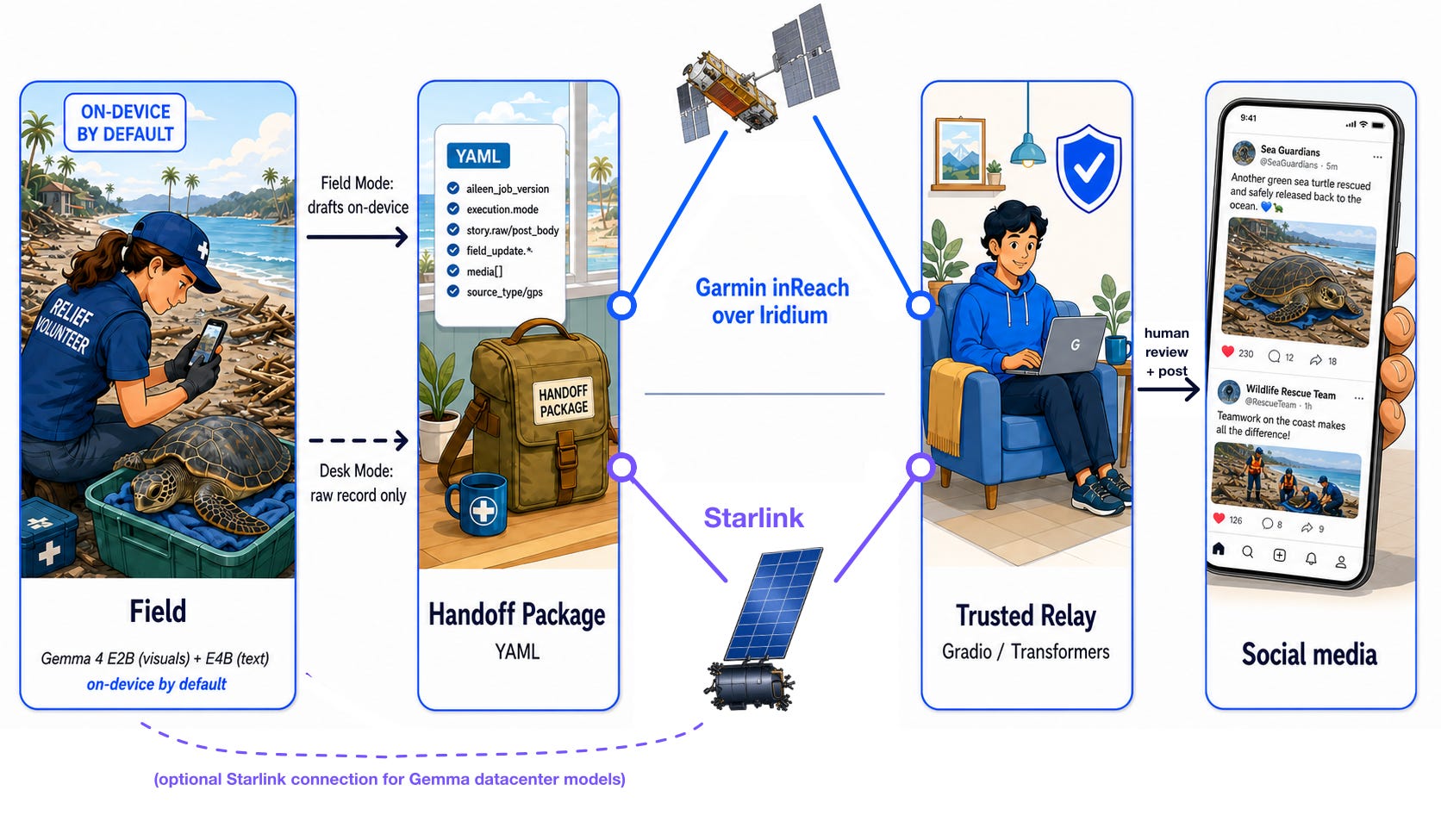
Aileen 4 starts from that uncomfortable reality: public updates, fundraising, and visibility matter - but they should not consume the people already carrying the relief work. Aileen 4 is an AI-native, satellite-aware system for moving from field notes and visuals to reviewed social-media updates. I built two connected apps around a conservative disaster assumption: connectivity is fragile, battery is limited, provenance matters, and a human must remain in control.
Core design principles:
Human-in-the-loop: Aileen drafts, checks, and proposes; people review and decide what gets posted.
Edge-first: a Gemma 4 edge model can run locally on the phone when cloud inference is unrealistic.
Satellite-aware: compact handoff packages support low-bandwidth, high-latency field-to-desk workflows.
Provenance-conscious: the system assumes that metadata alone is fragile across messenger and satellite handoffs.
A few practical lessons from the build:
MCoT inspired visual scratchpads can work, but extended reasoning introduces even higher latency and risks thinking budget overrun with Gemma 4
SCAFFOLD inspired coordinate grids were not enough on their own; spatial reasoning improved when Gemma 4 saw the clean source image plus concrete visual anchors for the overlay text being placed.
Smaller edge models reward narrow tool contracts more than elaborate prompts.
Metadata-carried provenance, including C2PA assertions, is fragile across real-world handoffs. Visible provenance markers and separate out-of-band records are harder to lose.
Codex was useful not only as a coding assistant, but as a meta-tool for iterating prompts, tool contracts, and synthetic test data.
I also published a compact overlay-placement benchmark: synthetic nature-conservation scenes with story prompts, control placements, and a grading schema. The goal is to turn a fuzzy visual failure - “the added overlay text covers the thing that matters” - into something that can be evaluated automatically.
Conclusion: on-device multimodal AI is functional. Its most credible role lies not in autonomy, however, but in disciplined augmentation - both technical and human.
All materials are already public - the Kaggle writeup links to the source code, live demo, and dataset: Aileen 4 Disaster Relief.